OM3-L Object Marker (Type 3)
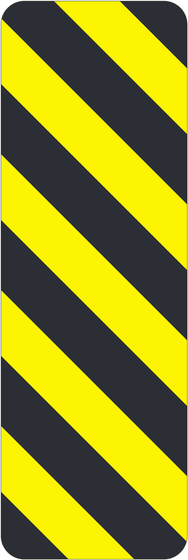
A striped Type 3 object marker used to mark the end of a roadway or a substantial obstruction, with stripes indicating the direction to pass.
- Sign Name
- Object Marker (Type 3)
- General Meaning
- A striped Type 3 object marker used to mark the end of a roadway or a substantial obstruction, with stripes indicating the direction to pass.
- MUTCD Code
- OM3-L
- Typical Use
- At (or leading up to) the obstruction it marks, per CA MUTCD object-marker standards.
- Sign Category
- Object Markers
Specifications
- Standard Shape
- Rectangle (Vertical)
- Background Color
- Alternating Yellow And Black Stripes
- Legend / Symbol
- Black legend
- Border
- Black
- Reflectivity
- High Intensity (for nighttime visibility)
- Compliance
- MUTCD / CA MUTCD
Standard Sizes (inches)
- Conventional Rectangle (Vertical)24"–48" tall
- Expressway Rectangle (Vertical)36"–60" tall
- Freeway Rectangle (Vertical)48"–72" tall
Material / Application Notes
Marking the end of a closed roadway. Confirm placement and supplemental plaques against the applicable CA MUTCD standard.
View this sign on the Federal MUTCD (FHWA)California Notes
California-specific application notes and adoptions may differ. Review California requirements where applicable.

What It Means / When This Sign Is Used
In the field, OM3-L Object Marker (Type 3) is typically positioned at the at (or leading up to) the obstruction it marks, per ca mutcd object-marker standards. Common deployments include marking the end of a closed roadway; mounted on barricades at closures; directing traffic around full obstructions. Always confirm its size, retroreflective sheeting, spacing, and placement against the CA MUTCD 2026 and the reviewing agency before finalizing the traffic control plan.
Learn more about Object Marker (Type 3) sign requirementsWhen & Where It's Used
- Marking the end of a closed roadway
- Mounted on barricades at closures
- Directing traffic around full obstructions
Placement on a Traffic Control Plan
- Where it sits
- At (or leading up to) the obstruction it marks, per CA MUTCD object-marker standards.
- CA MUTCD reference
- CA MUTCD Part 2, Chapter 2C (Warning Signs and Object Markers)
- Typical minimum size
- Per CA MUTCD object-marker standards
California / Field Use Notes
Used in California at the end of a closed roadway or on barricades to mark a full obstruction and direct traffic to the open side.
In Los Angeles, this sign must conform to CA MUTCD 2026. Work in City of LA right-of-way is reviewed by StreetsLA and the Bureau of Engineering (BOE); state highways in LA County are permitted and reviewed by Caltrans District 7; county roads are permitted by LA County DPW. Sizes, retroreflectivity, and placement must meet CA MUTCD minimums — local agencies may require larger signs based on roadway class, speed, pedestrian volume, and proximity to schools or transit.
Common Plan Review Comments
- Object marker omitted on a hazard that remains near traffic.
- Stripe direction does not guide traffic to the correct side.
- Marker type not appropriate for the obstruction.
- Delineation not continuous with the channelizing devices.
Confirm Type 3 markers are used at closures and roadway ends with the correct stripe direction. Public Ready reviews closure delineation.
Public Ready Sign Maker
OM3-L Object Marker (Type 3)— fabrication & stripe layout reference

Front view — OM3-L
Panel & Stripe Details
- Sign
- OM3-L — Object Marker (Type 3)
- Standard panel sizes
- 12" × 24" (worked example); 12" × 36" for taller objects — panel size is based on the object
- Width (W)
- 12"
- Height (H)
- 24"
- Corner radius
- 1" to 1.5" (typical); dimensions are taken to the corner, ignoring the radius
- Stripe direction
- Diagonal stripes sloping downward at 45° toward the side on which traffic is to pass (down and to the right for OM3-R).
- Diagonal stripes
- 7 total — 4 black, 3 yellow (first and last corner stripes are black)
- Stripe widths
- Yellow 3.5"; black 3.738" (black 7% wider than yellow)
- Colors
- Black + retroreflective yellow (Type 3 object marker sheeting)
Fabrication layout for the OM3-L Object Marker (Type 3). Type 3 object markers use alternating black and retroreflective yellow diagonal stripes. The stripe count and widths are derived from the panel size using the MUTCD striping method below. Panel dimensions are taken to the corner, ignoring the corner radius.
d = 0.707 × H + 0.707 × W
where W is the panel width and H is the panel height.
How the stripe layout is determined
- 1Determine the panel size from the object it is attached to. Object markers typically have 1" or 1.5" corner radii, but dimensions are taken to the corner (ignoring the radius).
- 2Calculate d = 0.707·H + 0.707·W, where W is the width and H is the height of the marker.
- 3Divide d by 3 and round DOWN to the nearest ODD number — this is the number of diagonal stripes.
- 4The first and last (corner) markings are black to preserve the diagonal shape of the retroreflective yellow stripes, so the number of black stripes is half the total rounded up, and the rest are yellow (hence the odd count).
- 5Black stripes should be 5–10% wider than the yellow stripes (the extra space goes to the darker stripes for better appearance).
- 6Yellow stripes should be 3" wide. If a 3" yellow stripe can't keep the black within 5–10%, increase the yellow width in 1/4" increments until it does.
- 7For center markers, design the pattern as a left or right marker, then mirror it about the vertical center line.
Worked example — 12" × 24" marker
- Size: width W = 12", height H = 24".
- d = (0.707 × 24) + (0.707 × 12) = 25.452".
- 25.452 ÷ 3 = 8.484 → round down to the nearest odd number = 7 stripes.
- 7 stripes → 4 black and 3 yellow.
- Yellow at 3": 3 × 3" = 9"; remaining 25.452" − 9" = 16.452" ÷ 4 = 4.11" black — 37% wider than yellow (too wide).
- Yellow at 3.25": remaining 15.702" ÷ 4 = 3.92" black — 20% wider (still too wide).
- Yellow at 3.5": 3 × 3.5" = 10.5"; remaining 14.952" ÷ 4 = 3.74" black — 7% wider (within 5–10%, OK).
- Result: three 3.5" yellow stripes and four 3.74" black stripes.
Fabrication & Layout Notes
- Lay the diagonal stripes at 45° across the full panel; corner stripes are black.
- Use retroreflective yellow sheeting for the yellow stripes and matte/retroreflective black for the black stripes, per the object-marker sheeting requirement.
- Measure panel width and height to the corner; the corner radius (1"–1.5") does not change the stripe layout.
- For a Type 3 center marker (OM3-C), mirror the diagonal pattern about the vertical center line to form the chevron.
Source References
- CA MUTCD Part 2, Chapter 2C (Warning Signs and Object Markers)
- MUTCD — Object Markers (Part 2, Chapter 2C)
- FHWA Standard Highway Signs — object marker layout
This information is provided as a fabrication reference only. Verify all sizes, stripe widths, colors, and sheeting against the current MUTCD / California MUTCD and the reviewing agency before production.
Related Signs
View All OM-Series SignsEducational reference only. This is not an official Caltrans, FHWA, or local agency publication and is not legal or engineering advice. Always verify sign selection, size, placement, spacing, and application against the current CA MUTCD 2026, Caltrans sign specifications, Standard Plans, project documents, and the reviewing agency’s requirements. Local jurisdictions may impose additional requirements, and final selection, placement, and dimensions may require engineering judgment or agency approval. Written against California MUTCD 2026 (effective January 18, 2026) and the Federal MUTCD 11th Edition. Official sources last verified June 2026.
Need to Rent or Purchase This Sign? Contact Public Ready.
Public Ready supports sign selection, project-ready sign packages, and equipment sourcing through qualified providers — with expert support built for compliance.